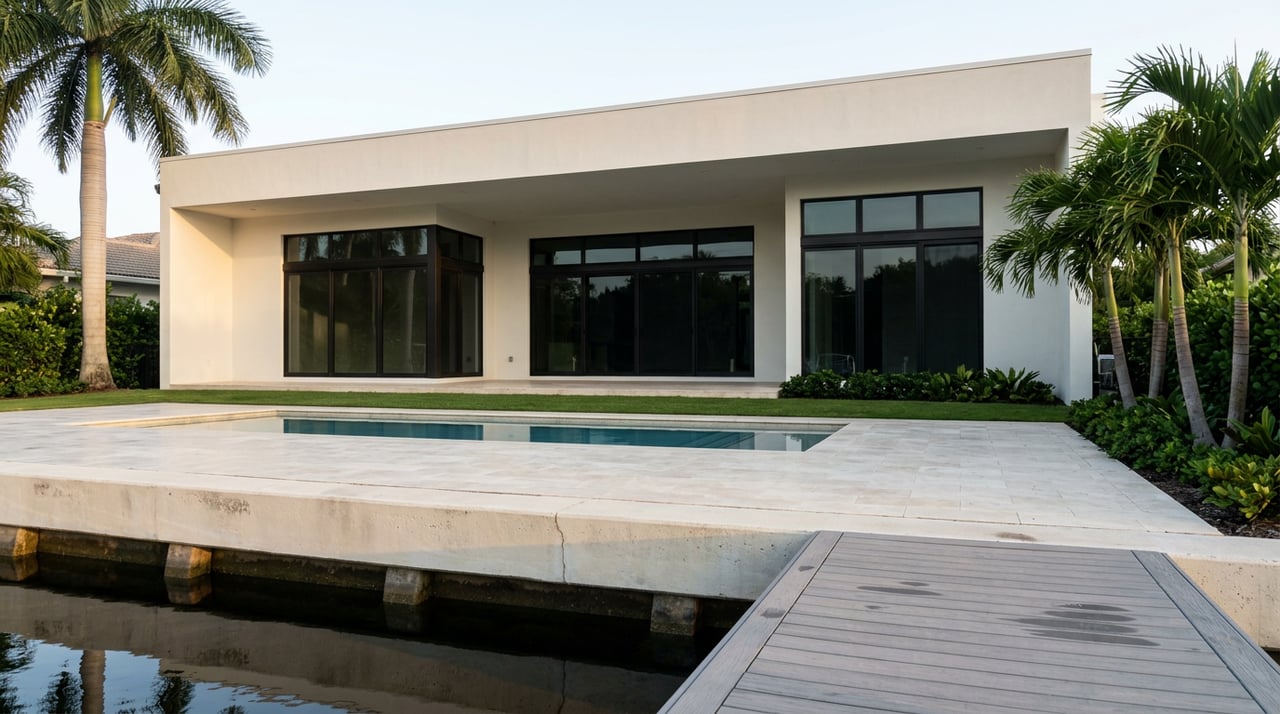
I was walking a dock behind a Gordon Drive estate this spring when the listing agent said something that stopped me mid-step. The wall looked immaculate. Fresh cap, clean lines, not a stain on it. But when I knelt down and ran a hand along the seam where the cap met the panel, I found the hairline map-cracking that shows up right before a wall starts talking to you. Nine years of general contracting work teaches you to read concrete the way an inspector reads a roof. A crack that fine on a wall that clean usually means one thing: the finish was redone, but the structure underneath was never brought up to today's standard.
That distinction, between a seawall that looks right and a seawall that is certified right, has become the single most consequential unwritten line item in a Port Royal transaction. It does not show up in the photos. It rarely comes up in the first showing. And it is exactly the kind of fact a buyer's team finds during due diligence, not before.
The Number the Listing Photo Can't Show
Every Port Royal listing sells the same visible math: linear feet of Gulf frontage, dock length, distance to Gordon Pass. What none of that math captures is whether the wall holding the property together was built to withstand what the Florida Building Code now requires.
Since Hurricane Ian, seawall panels in storm surge zones must be engineered to withstand Category 3 surge loads. That is a materially higher bar than what governed construction through most of the twentieth century, and it is a bar that a large share of pre-2000 walls cannot clear without reinforcement. A wall can be structurally sound by the standard it was built to and still fail the standard it is now measured against. Neither condition is visible from a boat, a dock, or a walk-through.
Why 2022 Became the Line
Hurricane Ian did more than damage property along Naples Bay. It exposed systemic weaknesses in the older concrete panel systems that make up a large share of the area's waterfront infrastructure, and Collier County's building standards were revised in response. The result, for many seawalls examined after the storm, was a choice between full reconstruction and cap replacement paired with riprap toe protection at the base. Neither is a cosmetic fix. Both are structural interventions that follow an engineering finding, not a homeowner's preference.
This is not a Port Royal-specific rule. It applies anywhere in the county with waterfront exposure. What makes it a Port Royal story is how many properties in this particular neighborhood sit on the wrong side of the age line.
Port Royal's Particular Math
Port Royal was carved out of mangrove in the 1950s, and its canal system matured through the 1960s and 1970s, the decades when most of its original seawalls went in. Those walls are now reaching 50 to 60 years of service life in an aggressive tidal saltwater environment, which is already a long run for concrete and steel exposed to salt intrusion twice a day. Layer the current code requirement on top of that age curve, and a large share of the neighborhood's original waterfront infrastructure is aging into obsolescence at the exact moment the standard it needs to meet got harder.
The geography compounds it. Port Royal has no bridges between its canals and the Gulf, which is the feature that makes it one of the few Naples addresses where a true motor yacht can move in and out on its own schedule. That same open water access means less buffering from wave energy and boat wake than a homeowner would get in a more sheltered, bridge-restricted canal system. The walls take a harder daily beating, and in the narrower canals, that wake concentrates wave energy directly on the panels, accelerating cap cracking and weep-hole or tie-back failure over time.
Flood zone data adds a third layer. Most Port Royal properties sit in FEMA-designated AE zones, but many Gulf-front homes fall into VE zones, the velocity classification reserved for parcels exposed to wave action during a storm, not just rising water. VE zones are precisely where the new surge-load standard matters most, because they describe the properties most likely to take a direct wave hit rather than a gradual flood.
The Four Signatures a Seawall Job Actually Needs
If a wall does need reinforcement or replacement, the work itself is straightforward. The paperwork is not. A seawall or dock project in Naples typically requires four separate approvals before a contractor can drive a single piling:
- A City of Naples marine permit, processed through the city's own portal
- A Collier County marine permit through the county's PRMAR process
- Florida Department of Environmental Protection review for any work touching state waters
- U.S. Army Corps of Engineers coordination for anything involving dredging or navigable waterways
The permit fees themselves are almost beside the point. A dock or seawall permit runs roughly thirty cents per square foot with a hundred-dollar minimum, plus a plan review fee equal to twenty percent of that cost. That is not where the money goes. The exposure lives in the reconstruction bill that follows once an engineer's report comes back, and in a neighborhood with this much original 1960s and 1970s infrastructure still in the ground, that report is not a hypothetical for every buyer walking through a Gordon Drive listing.
What This Means at the Closing Table
For a seller, the smart move is to get ahead of the question rather than let it surface during someone else's inspection period. A written condition assessment from a licensed marine contractor, done before the home goes on the market, turns an unknown into a documented fact. It also signals exactly the kind of transparency that a sophisticated Port Royal buyer expects and respects. Long-tenured waterfront associations in Port Royal and neighboring Aqualane Shores already commission these reviews annually for shared infrastructure, walking the docks and seawalls each year and logging findings into a written repair priority list tied to reserve planning. An individual estate owner can do the same thing on their own timeline, and the documentation is worth more at the negotiating table than a fresh coat of paint on the cap.
For a buyer, the question to ask is not whether the seawall looks fine. It is whether there is a written engineering assessment on file, when the wall was last inspected, and what the permit history shows. Ask specifically whether the wall has been evaluated against the current surge-load standard, not just against storm damage. On a Gulf-front lot in a VE zone, that answer carries more weight than almost any other line item in the inspection period.
One more thread worth pulling during diligence: portions of the Port Royal canal system fall inside a City of Naples special assessment district established to fund canal dredging and keep the waterways navigable. That is a separate question from seawall condition, but it belongs on the same checklist, since both determine what it actually costs to keep deep-water access working the way the address promises.
The Quiet Capital Item Next to the Loud One
Port Royal is in the middle of a very public capital project right now. The Port Royal Club's clubhouse renovation remains on track for a fourth-quarter 2026 reopening, and it is the kind of investment everyone in the neighborhood is watching and discussing. The seawall behind an individual estate is the opposite kind of project. Nobody is watching it. There is no groundbreaking photo. But for the buyer sitting across the table from a nine or ten figure purchase, it is very often the more consequential number, because it is the one that was never on the listing sheet in the first place.
A Short FAQ
Does a pre-2000 seawall automatically need to be replaced? No. It needs a current engineering assessment measured against the surge-load standard. Some walls can be reinforced rather than fully rebuilt, depending on what the assessment finds.
Who actually performs a seawall condition review? A licensed marine contractor or coastal engineer familiar with Naples Bay conditions typically walks the wall, the dock, and the hardware, then delivers a written report with photos and a ranked list of what needs attention and when.
Is the permitting process itself expensive? No. The fees are modest relative to the property values involved. The cost that matters sits in the construction work that follows an engineering finding, not in the paperwork that authorizes it.
If you are evaluating a Port Royal property, on either side of the transaction, this is exactly the kind of due diligence I bring to the table. Nine years of hands-on general contracting work means I read a seawall the way I read a roof or a foundation, and three decades spent building cases on evidence and documentation means I do not let a missing engineering report get lost in the excitement of a Gulf-front closing. If you would like a second set of eyes on a Port Royal property, or want to understand what your own waterfront infrastructure is actually worth in today's market, Shannon Spalding would welcome the chance to walk the dock with you. Schedule a Free Consultation to start the conversation.