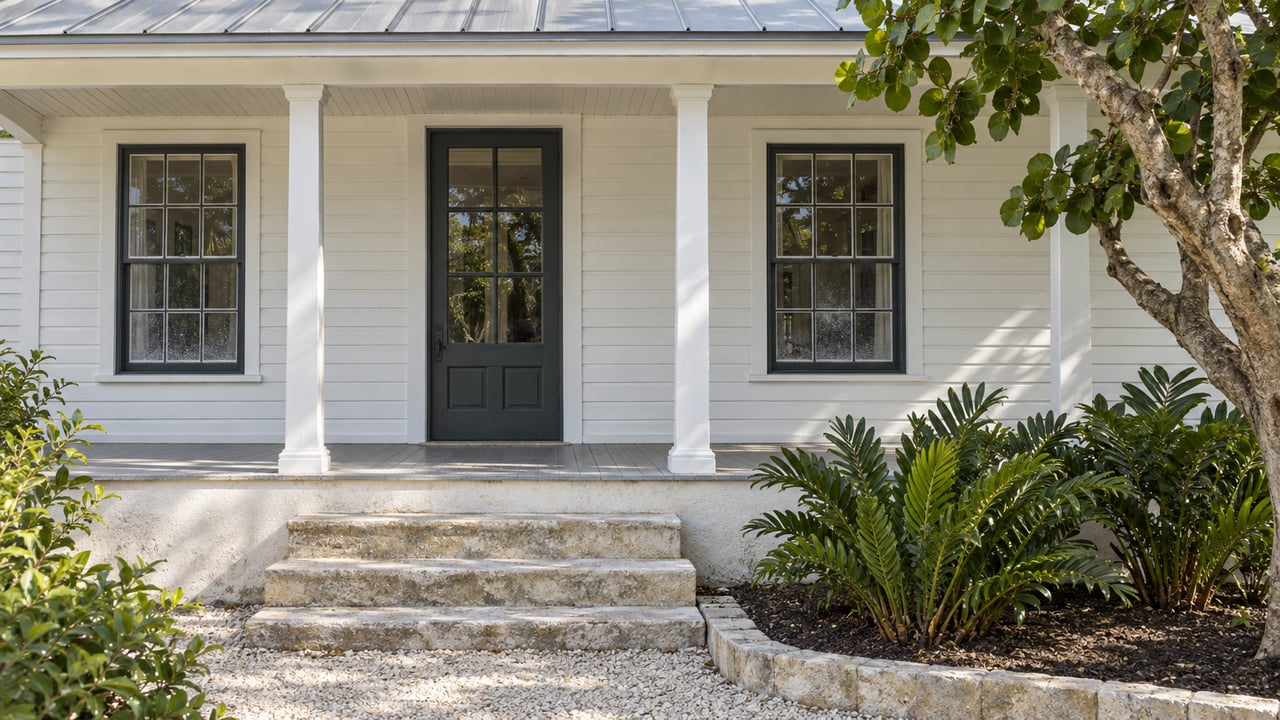
Does a $6,800 kitchen refresh inside a historic cottage on Fourth Avenue South need a building permit under Florida's new law?
The honest answer depends on a single line on a flood map, not on the price tag.
Florida's legislature spent this year's session trying to make small home projects easier. Governor DeSantis signed CS/CS/HB 803 on May 6, 2026, and as of July 1 it requires every local government in the state to exempt single-family homeowners, and their contractors, from needing a building permit for work valued under $7,500. It sounds like the kind of rule that would matter to anyone updating a cottage inside the Naples Historic District, the 500-acre core of Old Naples that runs from 9th Avenue South down to 13th Avenue South along the Gulf. It mostly doesn't. The exemption everyone read about in the spring carves out flood hazard areas entirely, and flood hazard areas describe nearly all of the ground this district sits on.
The exemption that actually governs what you can do to one of these homes predates HB 803 by years. It lives in a single section of the city's own floodplain code, and it works in the opposite direction: instead of skipping the permit process for small jobs, it protects historic homes from a much larger financial trigger buried inside the Florida Building Code.
Why the $7,500 Shortcut Stops at the Flood Line
HB 803, now Chapter 2026-63 of the Laws of Florida, is narrower than the headlines suggested. To qualify, work has to be non-structural and it can't touch electrical, plumbing, mechanical or HVAC systems, or gas lines. The homeowner or contractor still has to submit a written exemption request to the city before starting. And the law is explicit that none of this applies to a property located partially or entirely within a flood hazard area, regardless of what the work costs.
The City of Naples posted its own explainer on the new law, confirming the same terms locally: five trades excluded outright, a written request required either way, and flood hazard properties excluded from the exemption entirely. Old Naples, fronted by the Gulf of Mexico with Moorings Bay and Naples Bay winding through its canal system, is exactly the kind of ground the exclusion was written for. A homeowner three blocks from the historic district in a non-flood-zone pocket of the city might genuinely skip a permit on a small painting or trim job this fall. A homeowner inside the district, on a lot that has been mapped as a Special Flood Hazard Area since the city's 2024 Flood Insurance Rate Maps took effect, generally cannot use this shortcut at all.
The Exemption That Actually Governs a Historic Cottage
The Florida Building Code has long included a rule that matters far more to this neighborhood than HB 803 ever will: the substantial improvement rule. If the cumulative cost of repairs, renovation, or additions to a structure reaches 50 percent or more of its current market value within a one-year period, the entire building has to be brought up to today's flood elevation standards. For a raised concrete home a few blocks inland, that might mean new mechanical placement. For a wood-frame or tabby-mortar cottage built before elevation requirements existed, it can mean lifting the house.
Naples added Section 16-116 to its floodplain code specifically to give historic structures a way around that outcome. A home recognized as historic, either individually or as a contributing building within the National Register district, can apply for an exception to the substantial improvement trigger. The Building Official and floodplain administrator can grant it, provided the work won't cause the structure to lose its historic designation and the relief requested is the minimum necessary to preserve its character. This is the exemption that decides whether a fixer-upper cottage stays a cottage or becomes a construction project measured in the hundreds of thousands of dollars.
| HB 803 exemption (Ch. 2026-63) | Historic building exemption (Sec. 16-116) | |
|---|---|---|
| Applies to | Any single-family home statewide | Homes listed in the National Register, individually or as a contributing structure in a historic district |
| What it exempts you from | The permit requirement itself, for small non-structural jobs | The 50 percent substantial improvement trigger that forces full flood-elevation compliance |
| Flood hazard properties | Excluded entirely, at any dollar value | The entire reason the exemption exists |
| Effective | July 1, 2026 | Already in force under current Naples Code |
The Path, If Your Cottage Qualifies
The process runs through two local offices before it ever reaches a state agency, and the sequence matters because it changes the timeline.
- Confirm the house is recognized as historic and sits inside the district, or is individually eligible if it sits outside it. The Naples Historical Society and the city's Building Official both answer this question directly.
- If the project touches the exterior, doors, windows, roofing, or siding, the plans go to the Florida Division of Historical Resources for review. That office has up to 30 days to respond.
- Interior-only work skips that step entirely and moves straight to the local historic building permit application.
- The homeowner submits the completed application, a historic building exemption form, a floodplain elevation certificate, a hazard mitigation plan, and a letter of support from the Historical Society through the city's online permitting portal.
- Once the Building Official approves, the permit is fast-tracked.
One detail is easy to miss and worth knowing before you budget a renovation: appraisals aren't required for eligible historic structures going through this process. Outside the historic exemption, testing whether a project crosses the 50 percent threshold usually means paying for a market-value appraisal first. Inside the district, that cost and that step disappear.
Scope also matters at a different size. Any addition of 1,000 square feet or more triggers a separate layer, compliance with the city's Construction Site Ordinance and a Planning Department review for zoning. That's a different conversation than the flood exemption, and it applies regardless of historic status.
What a 1895 Cottage Shows About the Stakes
Palm Cottage sits at 137 12th Avenue South, a block from the pier, inside the same boundary this exemption was written to protect. Built in 1895 by Walter N. Haldeman, one of Naples' founding residents, it's constructed of tabby mortar, a hand-mixed blend of sand, shells, and water that few other buildings in the city still use. It was added to the National Register of Historic Places on May 24, 1982, survived a hurricane in 1944, and today serves as the Naples Historical Society's headquarters and house museum.
It's a useful reference point because it's the oldest example of exactly the building stock the district was drawn around. The National Register listing covers 65 historic houses and two historic commercial buildings across the full 500 acres, alongside 26 non-contributing structures built more recently on the same blocks. A newer home inside those boundaries doesn't automatically qualify for the Section 16-116 exemption just by being in the neighborhood. Eligibility runs with the structure's own historic recognition, not with its street address.
That distinction is where the Historical Society's role becomes practical rather than ceremonial. The same organization that maintains Palm Cottage is the one a homeowner calls first to confirm whether their own cottage qualifies for relief from the same flood code that would otherwise force a full elevation retrofit.
Before You Sign a Renovation Contract
A few questions are worth asking before committing to scope or budget on a historic cottage purchase in this district.
Has the home's flood hazard designation been confirmed against the city's current maps, and is that designation the reason a contractor's HB 803 estimate might not hold up. Has the home already been through the Section 16-116 process at any point, since a cottage with that exemption on file has a clearer renovation runway than one that hasn't started the conversation. Does the scope include exterior work, since that adds the state review window that interior-only projects skip. And does the addition, if there is one, cross the 1,000 square foot line that pulls in a separate zoning and site ordinance review.
None of this makes a historic Old Naples cottage harder to love. It makes the difference between a renovation that proceeds on a predictable timeline and one that stalls over a permit assumption that never applied to begin with.
A Short FAQ
Does every home in Old Naples qualify for the historic exemption? No. Eligibility is tied to a structure's own recognition on the National Register, individually or as a contributing building within the historic district. The same 500-acre boundary includes 26 non-contributing buildings that don't carry that status.
Does the HB 803 exemption help at all in this neighborhood? It can, for interior cosmetic work on a property confirmed to sit outside a flood hazard area. Given how much of Old Naples was remapped into flood zones under the city's 2024 maps, that confirmation should happen before assuming the shortcut applies.
What if the project is larger than a small refresh? Additions of 1,000 square feet or more require Planning Department zoning approval and Construction Site Ordinance compliance in addition to, or in place of, either exemption discussed here.
A historic cottage purchase in Old Naples comes with more moving parts than the listing photos suggest, and getting the sequence right before you sign a renovation contract is where design judgment and construction experience matter as much as the offer itself. If you're weighing one of these homes and want a clear read on what a specific property can and can't do under this exemption, Shannon Spalding is a good place to start that conversation.